The event DJ glossary:
equipment and music terms explained simply
When you plan an event you quickly run into terms such as PA, line array, rider or DMX – you do not need to know them by heart without a technical background, but a basic understanding makes coordinating with your DJ and the venue considerably easier. This glossary explains the most important equipment and music terms briefly and clearly, so that you can hold your own when the venue or the DJ asks a question. All the explanations are deliberately compact and free of unnecessary jargon.
Which terms should you know as an organiser?
The most important terms fall into three groups: sound (PA, line array, subwoofer), lighting (uplights, moving heads, DMX) and organisation (rider, GEMA, backup system, running order). Knowing these basics makes quotes and conversations with the DJ much quicker to follow.
PA / sound system
PA stands for “public address” and means the entire sound system of an event – all the speakers, amplifiers and mixers that make music and announcements audible in the room. The right PA size follows guest numbers, room size and acoustics, not a fixed rule. More on matching equipment to your event can be found in our article on sound and lighting for your event.
Line array
A line array is a vertically arranged column of several small speakers which together provide even coverage over long distances. It is used above all at larger events or in rooms with many guests. For smaller events a line array is usually not necessary.
Subwoofer
A subwoofer is a speaker that reproduces only low frequencies (bass) and supplements the rest of the PA. It gives the music on the dance floor punch and fullness without overloading the main speakers. For pure background sound, during a dinner for example, the subwoofer is often used deliberately sparingly.
wireless microphone
A wireless microphone transmits speech to the PA without cables – ideal for welcomes, speeches or hosting, since the speaker can move freely around the room. A professionally levelled wireless microphone avoids feedback (that unpleasant whistle). In our “complete” package a wireless microphone is a fixed part of the equipment.
Monitor
A monitor is a speaker that faces not the audience but the DJ or speaker – so they can hear themselves clearly without depending on the main system. With larger stage set-ups or bands, a separate monitor feed is standard.
Mixer
The mixing desk (mixer) is the control centre of the sound: all the sources – music, microphones, further inputs – come together here and are balanced in volume and tone. An experienced DJ also uses the mixer to let announcements and music flow cleanly into one another.
DI box
A DI box (direct injection box) converts the signal from instruments or laptops so that it can be fed into the mixer without interference. It is often used when a presentation with sound or a live instrument has to be integrated alongside the DJ equipment.
Uplights / ambient lighting
Uplights are small light sources, usually placed on the floor, that light walls, columns or decoration from below and thereby create an atmospheric base lighting. Ambient lighting is the general term for discreet, atmospheric light – unlike intense dance floor lighting it is restrained and suits receptions, dinners or formal company parties particularly well.
Moving heads
Moving heads are motorised spotlights that can change direction, colour and effect automatically. They are used above all for dynamic dance floor lighting and can be programmed to match the music without becoming intrusive.
Truss
A truss is a framework of aluminium sections from which lighting or speakers are suspended. It is used when equipment should not stand on the floor or when a particular height is needed for the lighting.
DMX
DMX is the standard protocol used to control lighting digitally – it allows colours, movements and effects of all connected fixtures to be programmed and synchronised centrally. What matters for you as the organiser: thanks to DMX, lighting can be matched precisely to programme items such as an award presentation or the start of the dancing.
DJ booth
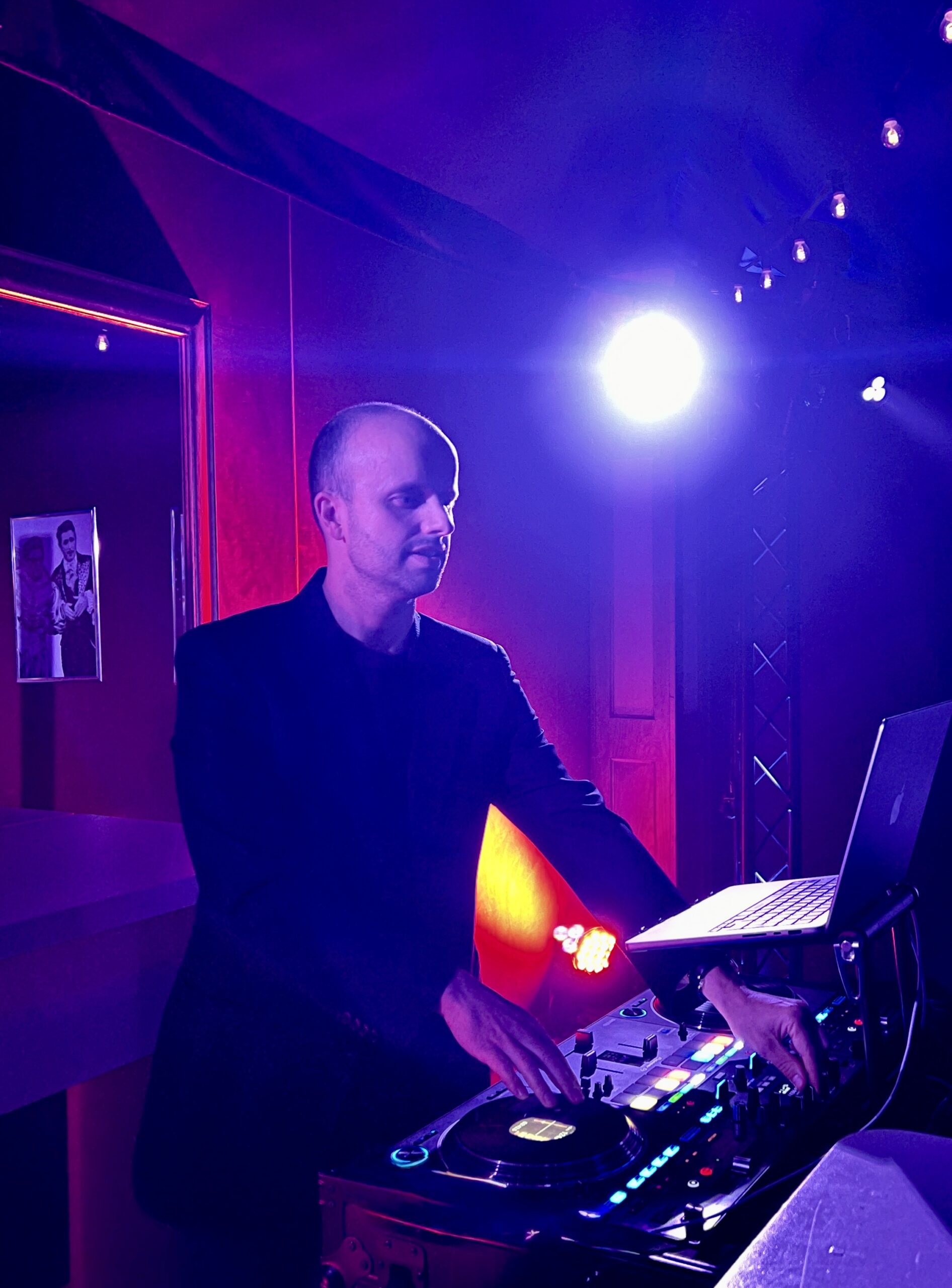
The DJ booth is the DJ’s workplace – a table or console, mixer, players and often a discreet front panel. At corporate events the booth is frequently kept deliberately unobtrusive so that it fits the formal overall picture.
Sound check / line check
The sound check is the technical test before the event begins: all microphones, sources and speakers are checked and levelled. A line check is the brief test of individual signal paths, shortly before a speech for example. Both should be finished before guests are admitted.
Playlist vs. individual music concept
A playlist is a track list fixed in advance and played rigidly. An individual music concept, by contrast, responds live to the crowd, the mood and the time of night – an experienced DJ reads the room and adapts the selection accordingly instead of following a list. That is exactly one of the reasons we work with individual concepts rather than plain playlists at corporate events.
Do-not-play
A do-not-play list contains tracks or genres that explicitly should not be played – at corporate events often certain genres that do not fit the company culture. It is the counterpart to music requests and helps the DJ avoid missteps.
GEMA
GEMA is the German collecting society representing music copyright. At events with music, a GEMA fee generally applies, which depending on the venue is either covered by a blanket contract or has to be registered separately – a point best clarified with your venue early.
Rider / technical rider
The rider (technical rider) is a list of the DJ’s technical requirements – power connections needed, space requirements or access times, for example. It helps the venue prepare in good time and avoids surprises on the day.
Backup system
A backup system means cover against equipment or personnel failure – through redundant units or a second DJ, for example. At EVENT DJs Berlin, the well-rehearsed two-DJ team of Malte and Dennis has provided exactly that for over 20 years: if a piece of equipment fails, a replacement is on site immediately, without your event coming to a halt.
Open end
Open end means no fixed finishing time has been agreed; the event runs as long as guests and venue allow – usually limited by the venue’s curfew. Additional hours beyond the booked time are normally billed separately.
Running order
The running order (timeline) lists all the programme items of an event in chronological order – from admission through speeches to the start of the dancing. It is the basis on which DJ, venue and caterer work in step with one another. How to build such a plan sensibly is covered in our article on the event running order and timing.
Do I have to know all these terms as an organiser?
No. But a basic understanding helps you compare quotes and reach agreements with the DJ and the venue more quickly – the actual technical delivery we take care of for you.
What is the key difference between PA and subwoofer?
The PA covers the whole frequency spectrum; the subwoofer specifically adds the low frequencies. Together they produce a balanced sound.
Do I need a technical rider for every event?
Not necessarily, but it makes sense from a certain size upwards or at demanding venues, so that power and space questions are settled early.
What does it mean when a DJ works with an “individual music concept” instead of a playlist?
They respond live to the crowd and the mood instead of playing a fixed list – which as a rule keeps the dance floor full all evening.
Who takes care of the GEMA registration and the technical rider at my event?
We clarify that with you and your venue in advance where needed, so that you do not have to deal with anything separately.
Still have questions about the equipment or the running order of your event?
Whether it is PA size, lighting concept or backup cover: when planning your Corporate Events we are happy to advise you on all technical questions and put together a suitable package. Take a look at our packages or contact us with no obligation.