Company party checklist & schedule:
how to plan your event in Berlin
A successful company party stands or falls on enough lead time and a realistic schedule: settle the occasion, budget, venue, catering, DJ and equipment in the right order and you avoid date stress and last-minute compromises. As a rough guide: the big items such as venue and DJ belong three to six months ahead; details like seating and running order about four weeks ahead. This article gives you a chronological checklist and a sample evening schedule for orientation.
Why lead time matters so much for a company party
Company parties compete for the same resources as many other events: good venues, sought-after caterers and experienced DJ teams book out quickly, especially around Christmas, in the summer party season and around anniversaries. Starting to plan only a few weeks ahead needlessly narrows your choice and puts you under time pressure on the details. A structured schedule, by contrast, brings calm – for you as the organiser and for every supplier involved, who can then prepare properly for your evening.
Which checklist do I need for planning a company party?
The overview below is built around three points in time: three to six months ahead, around four weeks ahead, and the day of the event itself. It does not replace an individual briefing, but it gives you a reliable thread to follow.
3–6 months ahead: set the framework
This early phase is about the big building blocks that are hard to move later:
- Clarify the occasion and the goal – summer party, Christmas party, anniversary or a pure team event? The goal determines tone, programme and budget.
- Set a rough budget – including venue, catering, equipment/DJ and decoration, so that later decisions are not made in the dark.
- Estimate guest numbers – even provisionally, because both the choice of venue and the sound and lighting you need depend on it.
- Book the venue – popular Berlin venues in particular are booked out early at Christmas and in summer.
- Reserve the DJ and equipment – experienced teams go quickly on good dates; book too late and the choice is often limited. Details on booking and the running order can be found on our page for the company party DJ in Berlin.
- Request catering quotes – gather offers and check availability for your date.
- Save the date for guests or staff – especially if travel or external guests are involved.
4 weeks ahead: work out the details
As the date approaches, it is time for the fine-tuning that makes the evening work:
- Draw up a running order with time slots – put reception, dinner, speeches, programme items and party into a rough timeline. How that works in detail is explained in our article on the running order & timing for your event.
- Finalise speakers and programme items – who speaks when, for how long, and is a wireless microphone needed?
- Discuss music requests and no-gos – agree with your DJ team which genres fit and where the limits are.
- Fix the seating and room plan – including space for the DJ booth, speakers and dance floor.
- Confirm catering finally – numbers, allergies and the timing of the meal.
- Organise decoration, signage, give-aways – everything that carries your company’s identity.
- Clarify the venue’s technical conditions – power supply, access, set-up times and any volume restrictions.
Event day: secure the running order instead of improvising
On the day itself, what counts most is that everyone involved knows the same plan and stays flexible:
- Agree set-up times with all suppliers, so that DJ, catering and decoration teams do not get in each other’s way.
- Sound check and wireless microphone test before guests arrive – so the first announcement later runs smoothly.
- Name an on-site contactwho can be reached quickly if anything changes at short notice.
- Build buffer times into the running order, since speeches and programme items in practice often run longer than planned.
- Shape the transitions between programme and party deliberately, rather than switching the music abruptly.
What does a typical evening schedule look like?
Even though every company party is individual, a sample schedule helps as a starting point. The table below shows one possible running order for an evening with around 150 guests – the exact length of each phase always depends on guest numbers, programme and venue.
| Time | Programme item | Musical focus |
|---|---|---|
| 6.30 – 7.00 pm | Reception / arrivals | Discreet background music, low volume |
| 7.00 – 8.00 pm | Get-together / networking | Lounge sounds, conversation to the fore |
| 8.00 – 9.30 pm | Dinner | Restrained underscoring, constant volume |
| 9.30 – 10.00 pm | Speeches & programme items | Music paused, wireless microphone, clear hosting |
| 10.00 – 10.30 pm | Transition to the party | Energy building step by step |
| 10.30 pm – 12.30 am | Dance floor / peak | Varied set, adapted live to the crowd |
| 12.30 – 1.00 am | Winding down | Tempo and volume deliberately reduced |
This framework is easy to adapt: at smaller parties the networking or programme phases are shorter, while larger galas often add items such as award presentations or stage performances. What matters in every case is planning realistic buffer times between the phases, so that delays do not drag through the whole evening.
The DJ as an early fixed point in your planning
One point is frequently underestimated in planning: good DJ teams are often booked out months ahead on sought-after dates – especially in November, December and through the summer months. Enquire only shortly before the date and you risk either falling back on an alternative date or a limited choice of equipment and services. So it is worth counting the DJ, alongside the venue, among the first things you fix.
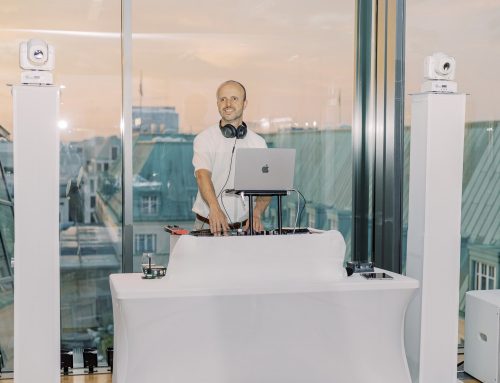
Beyond that, the DJ at a company party often does more than provide music: with a professional wireless microphone they make sure speeches and honours are clearly audible, they host the transitions between programme items and, together with sound and lighting, bring the right atmosphere for every phase of the evening. At EVENT DJs Berlin, Malte and Dennis have filled that role as a well-rehearsed two-DJ team for over 20 years – backup system included, should a piece of equipment ever fail. That keeps the evening stable even when the schedule shifts at short notice on the day.
How much lead time does planning a company party really need?
For venue, catering and DJ, three to six months of lead time is advisable, and earlier still for the heavily booked dates in November and December. Details such as the running order and seating can be settled about four weeks ahead.
When should we book the DJ for the company party?
Ideally at the same time as the venue, so three to six months in advance. Experienced DJ teams book out quickly on popular dates, so an early enquiry secures the widest choice of dates and services.
What absolutely has to be in the running order for the day?
At the very least the times for reception, dinner, speeches or programme items, the transition to the party, and realistic buffer times. How to build that schedule musically is explained in our article on the running order & timing for your event.
What happens if the schedule slips on the day?
Speeches and programme items running late are part of event life. An experienced DJ team responds live and adapts music and transitions flexibly, without the mood of the evening suffering.
Do smaller company parties need such a detailed checklist too?
Not in full. For smaller team celebrations a leaner framework with the key points is often enough. For larger company parties or events with several programme items, detailed planning pays off noticeably.
Planning the budget realistically
A schedule is only as robust as the budget behind it. As a rough guide for DJ and equipment: DJ sets can be booked from €850 net, each additional hour costs €150 net, and larger company parties with more extensive equipment and longer hours frequently come to around €2,500 net or more. A no-obligation enquiry via the prices page will quickly give you a first idea for your specific event.